
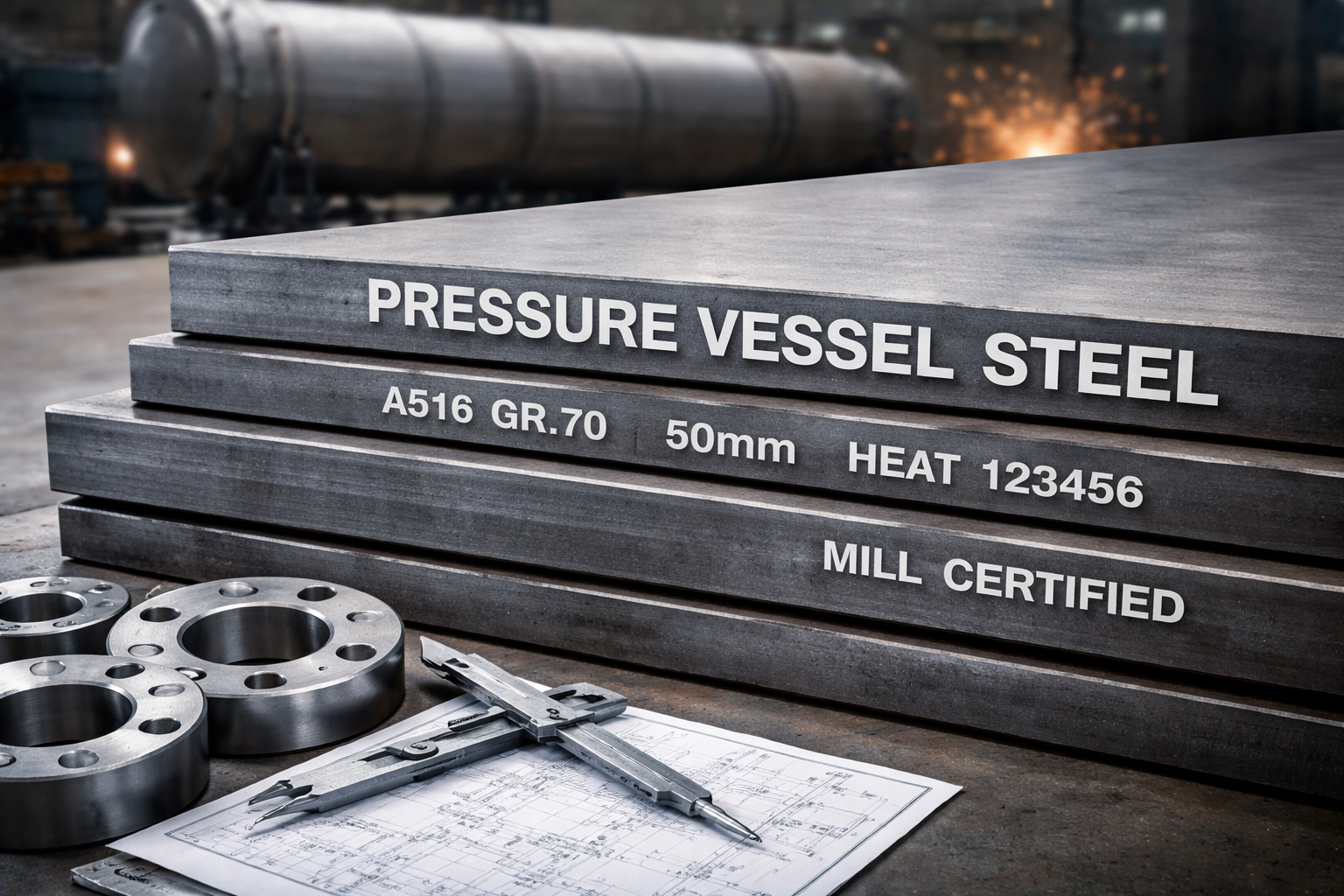
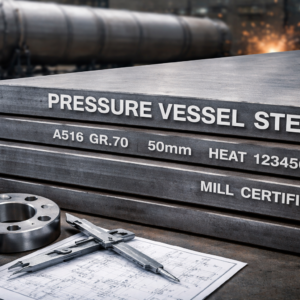
This steel category is manufactured with strict metallurgical controls to ensure superior toughness, weldability, corrosion resistance, and long-term mechanical stability. Pressure Vessel Steel plates are designed to meet international safety and performance standards, making them suitable for applications across oil & gas, petrochemical, power generation, marine, and heavy engineering sectors.
The material undergoes controlled rolling, heat treatment, and rigorous quality testing to ensure consistent grain structure and mechanical strength under extreme service conditions.
Key Features & Properties
| Feature | Description |
|---|---|
| High Strength | Designed to withstand internal pressure and mechanical stress |
| Excellent Weldability | Allows easy fabrication and structural joining |
| Superior Toughness | Maintains integrity under low and high temperatures |
| Corrosion Resistance | Suitable for chemical and harsh industrial environments |
| Thermal Stability | Performs reliably in elevated temperature operations |
| Compliance Ready | Meets international pressure vessel standards |
Common Material Grades
| Standard | Grade | Application |
|---|---|---|
| ASTM | A516 Grade 60 | Moderate temperature pressure vessels |
| ASTM | A516 Grade 70 | High strength boiler and vessel fabrication |
| EN | P265GH | Pressure equipment and steam boilers |
| EN | P355GH | High temperature and pressure vessels |
| ASME | SA516 Gr 70 | Industrial pressure containment systems |
Mechanical Properties Overview
| Property | Typical Range |
|---|---|
| Tensile Strength | 415 – 620 MPa |
| Yield Strength | 220 – 355 MPa |
| Elongation | 20 – 30% |
| Impact Resistance | High toughness performance |
| Hardness | Moderate hardness for fabrication flexibility |
Available Product Forms
| Form | Description |
|---|---|
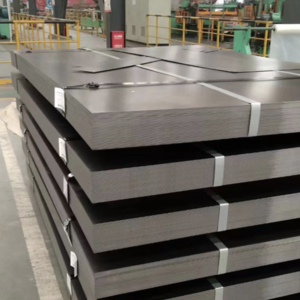
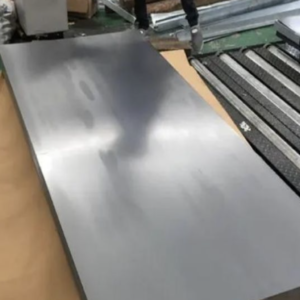
| Steel Plates | Heavy duty pressure vessel fabrication |
| Steel Sheets | Light and medium fabrication applications |
| Rolled Steel Sections | Cylindrical vessel manufacturing |
| Custom Cut Plates | Precision engineered vessel components |
Industrial Applications
| Industry | Usage |
|---|---|
| Oil & Gas | Storage tanks, separators, gas processing vessels |
| Power Generation | Boilers, heat exchangers, steam drums |
| Petrochemical | Chemical reactors and storage systems |
| Marine Industry | Offshore pressure containment systems |
| Industrial Manufacturing | Compressed air and gas cylinders |
Heat Treatment Options
| Treatment Type | Purpose |
|---|---|
| Normalizing | Improves grain uniformity and strength |
| Quenching & Tempering | Enhances toughness and fatigue resistance |
| Stress Relieving | Reduces internal fabrication stresses |
Quality & Inspection Standards
| Inspection Method | Objective |
|---|---|
| Ultrasonic Testing (UT) | Detects internal material defects |
| Radiographic Testing (RT) | Ensures weld integrity |
| Charpy Impact Testing | Verifies toughness at low temperatures |
| Chemical Composition Analysis | Confirms grade compliance |
Advantages of Pressure Vessel Steel
-
High operational safety reliability
-
Extended service life under extreme conditions
-
Cost-efficient fabrication compatibility
-
Excellent dimensional stability
-
Compliance with global engineering standards

Reviews
There are no reviews yet.