
Key Features & Properties
| Feature | Description |
|---|---|
| Corrosion Resistance | Designed to withstand saltwater and marine atmosphere exposure |
| High Strength-to-Weight Ratio | Enhances vessel efficiency and fuel economy |
| Fatigue Resistance | Handles constant wave and load stresses |
| Weldability | Supports large-scale structural fabrication |
| Impact Resistance | Maintains safety in rough sea conditions |
| Classification Compliance | Meets global marine regulatory standards |
Common Shipbuilding Material Types
| Material Type | Description | Typical Usage |
|---|---|---|
| Marine Structural Steel | High-strength hull construction steel | Ship hulls, decks, bulkheads |
| Marine Grade Aluminum | Lightweight corrosion-resistant alloy | Superstructures, patrol boats, ferries |
| Stainless Steel | High corrosion and chemical resistance | Tanks, piping, fittings |
| Copper-Nickel Alloys | Anti-fouling and seawater resistant | Cooling systems, seawater piping |
| Fiber Reinforced Composites | Lightweight reinforced structural panels | Luxury yachts, high-speed vessels |
Mechanical Properties Overview
| Property | Marine Steel | Marine Aluminum |
|---|---|---|
| Tensile Strength | 400 – 600 MPa | 250 – 350 MPa |
| Yield Strength | 235 – 390 MPa | 150 – 280 MPa |
| Corrosion Resistance | Moderate to High | Very High |
| Weight Efficiency | Heavy | Lightweight |
| Weldability | Excellent | Excellent |
Typical Shipbuilding Steel Grades
| Standard | Grade | Application |
|---|---|---|
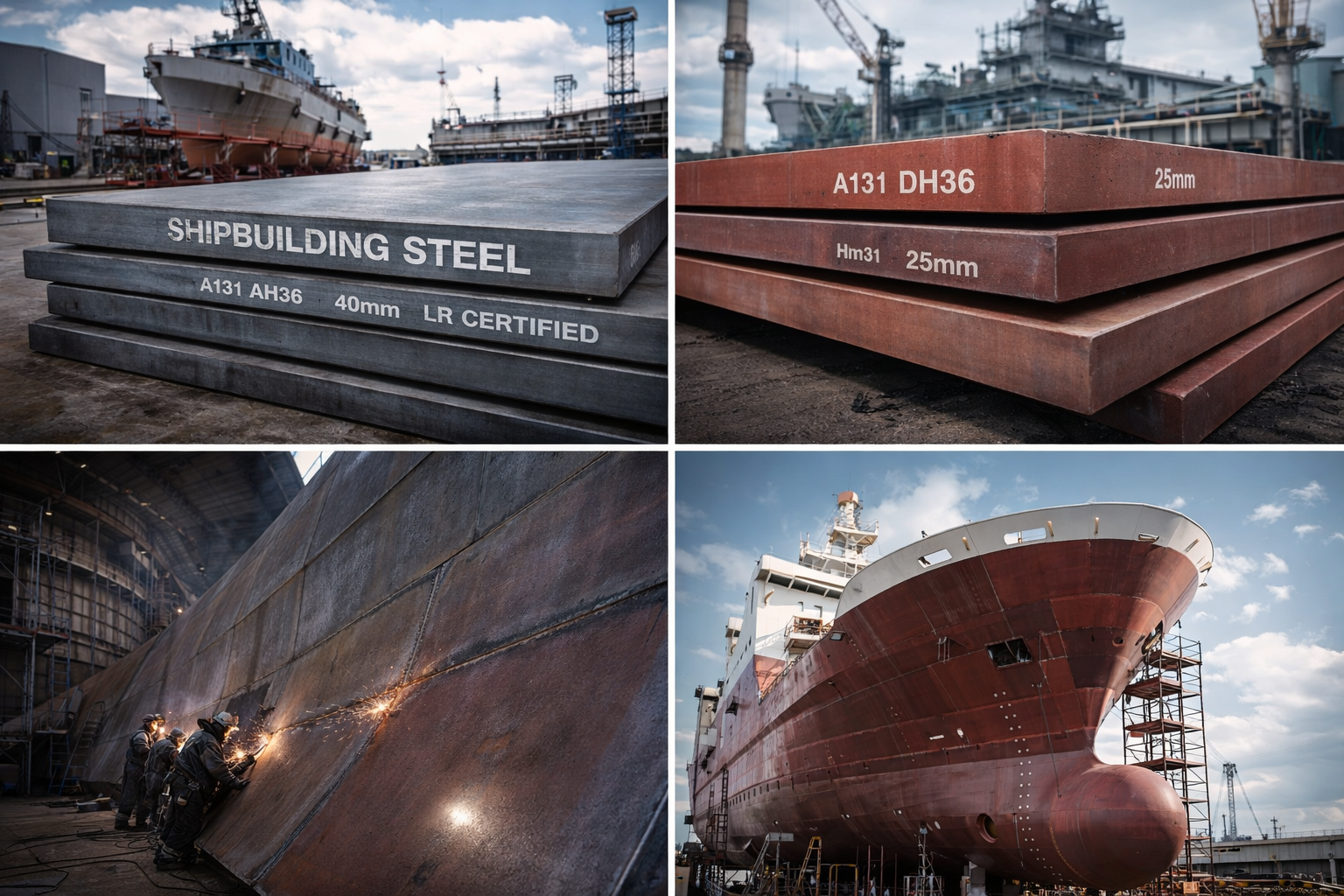
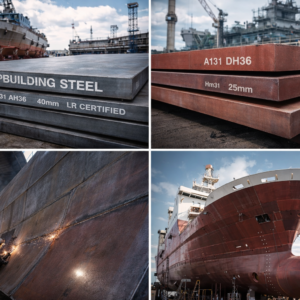
| ASTM | A131 AH36 | Hull structural plates |
| ASTM | A131 DH36 | Heavy-duty ship hull construction |
| EN | S355 Marine Grade | Structural ship components |
| Lloyd’s Register | Grade A, B, D | Certified marine vessel fabrication |
Available Product Forms
| Form | Usage |
|---|---|
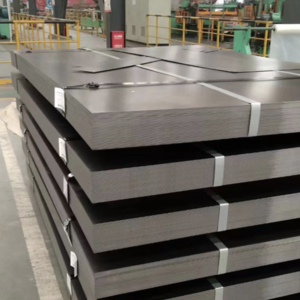
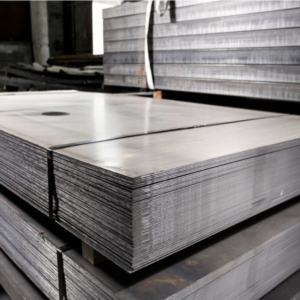
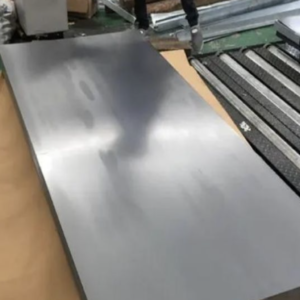
| Steel Plates | Hull, decks, bulkheads |
| Steel Sections | Structural reinforcement frames |
| Aluminum Sheets | Lightweight upper structures |
| Pipes & Tubes | Fluid transport and cooling systems |
| Composite Panels | Interior and specialized vessel components |
Industrial Applications
| Sector | Usage |
|---|---|
| Commercial Shipping | Cargo ships, tankers, container vessels |
| Naval Defense | Warships, patrol boats, submarines |
| Offshore Industry | Oil rigs, floating platforms |
| Marine Transport | Passenger ferries and cruise vessels |
| Luxury Marine | Yachts and recreational boats |
Heat Treatment & Processing
| Treatment | Purpose |
|---|---|
| Controlled Rolling | Improves structural grain strength |
| Normalizing | Enhances toughness and durability |
| Thermo-Mechanical Processing | Improves fatigue resistance |
| Surface Coating & Galvanizing | Provides corrosion protection |
Quality & Marine Certification Standards
| Certification | Authority |
|---|---|
| ABS | American Bureau of Shipping |
| DNV | Det Norske Veritas Marine Certification |
| Lloyd’s Register | Global marine compliance authority |
| BV | Bureau Veritas Marine Certification |
| ISO Marine Standards | International shipbuilding quality systems |
Advantages of Shipbuilding Materials
-
Long operational lifespan in marine environments
-
Enhanced vessel structural safety
-
Improved fuel efficiency through optimized weight
-
Resistance to biofouling and seawater corrosion
-
Compliance with international marine engineering regulations

Reviews
There are no reviews yet.